
Ontology - Chairs do not exist!
Ontology is the study of existence. In this article I will classify what it means for something to "exist" and make the argument that in the very manner that we define things to exist, that constructs such as chairs can inherently not exist empirically.
Jacob Blair
1/8/20266 min read
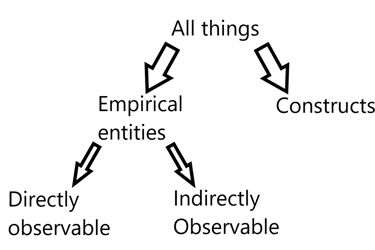
A generally accepted way to classify all things in the universe as either as an empirical entity or a construct. (For those screaming false dichotomy hold your horses).
Empirical entities are things that are observable directly or indirectly, while constructs are merely ideas.
All empirical entities can be classified into directly observable and indirectly observable. Direct observation is constituted by observing the thing, while indirect observation is constituted by observing the thing's influence.
Earth is a good example of a directly observable empirical entity, because one can look down and see it directly. Alternatively, something like a distant star that is visibly blocked may be measurable indirectly through its influence on other planets. Hence, the star would be a good example of an indirectly observable empirical entity.
The point is that all other things are either ideas or empirically observable. There are some immediate questions that may come to mind such as:
1) What defines observation?
2) What does it mean to directly observe something if observation inherently bears indirect influence?
3) Aren't constructs technically empirical as things of the mind can be observed even if we cant explain them?
All of these questions I intend to provide a resolute answer to by the end of this article by completing our philosophical framework and interjecting a bit of physics.
Classifying All Things
If you're walking down the street and someone comes up to you and asks, "Do chairs exist?" The first, reasonable instinct you may have is to look at them as though they are a complete lunatic and to say, "Yeah... chairs definitely exist..."
Alternatively, if someone asks you, "Do unicorns exist?" You may be inclined to say, "Definitely not."
The point here is that we have intuitions as to what things exist and don't that parameterize the semantics of the word "exist". However, this goes beyond semantics and becomes a question of what we are referring to.
Unicorns we would classify as a construct, while chairs are commonly directly observable empirical entities. In fact, this categorization is precisely how we define "existence". Commonly, begging the question if something exists is implicitly referring to the empirical existence. The idea of a unicorn most certainly exists as it is being discussed and (hopefully) understood right now. The physical, empirical entity of a unicorn does not exist, yet the idea remains.
Every time we say, "Does X-thing exist ?", we should be careful to clarify empirical existence vs constructive existence. - Is it the entity that exists, or the idea?
We have now begun our journey into the crux of the problem.
What actually "exists"
So now we agree that something "exists empirically" if it is observable. Great! I can directly observe a chair, and therefore it exists empirically. Problem solved... except, what is it that I am truly observing?
I mean if I look at a chair, technically what I am observing is the things that compose the chair because "chair" inherently is just an idea about the grouping of these fundamental things. The properties and groupings are all constructs. In fact, unavoidably the notion of chair as we understand it is a construct.
So if I am to "observe a chair", I am implicitly using the construct of the group of things that compose a chair to rationalize what I am seeing. Let's be very clear about what this means: Groups of these fundamental things are ideas, and by definition are constructs. So every time something is named or thought of, it is inherently tied to a construct.
Well regardless of if you have created a construct for the group or not, aren't these groups still observable and therefore exist empirically? Well, I would argue no! It is not the groups themselves that are observable, but only the fundamental constituents for which we assign the construct of a group label.
From here on we will refer to the fundamental constituents of the universe as simples. Consider a "snapshot" of the universe as it is right now. There are an infinite number of groupings of these simples that can exist, but we only have created constructs for a subset of them. Moreover, consider a chair in this universe sitting on a floor. If we were to look at it we would identify that the chair exists empirically, and separately that the floor exists empirically. I am now going to create a new group called "floor-chair" that is comprised solely by a chair on a floor. Prior to this sentence, the construct of floor-chair did not exist, yet the arrangement of the floor-chair's simples did empirically. If we had looked upon the floor-chair prior to its construct, there would be no constructive nor empirical existence of the floor-chair.
The problem is now precisely this: In order to say a group exists empirically, a group must be observable. In order for a group to be observable, the group must be defined. In order for the group to be defined, a construct of the group must be created. Thus, empirical observation of groups is construct-dependent and by definition dependent on a thing or influence which cannot be observed.
The floor-chair's simples exist independently of the mind, yet the floor-chair's existence is entirely dependent on the mind. Hence, it is only simples that can exist empirically independent of the mind.
The question now must be begged: How are simples able to be observed independent of the mind?
The answer lies in that no definition of grouping is required for observation. A chair requires understanding the group of simples (construct) in order to even recognize that it is a chair. Dissimilarly, a simple can be observed or have its influence observed without relative information to other simples.
What "empirically exists"
It is now high time that we define observation, and brace yourself, as many many connections to physics and previous underlying questions must be called upon for an accurate answer.
The scale of the simples in our observable universe lends itself to the world of quantum mechanics. Non-relativistic Quantum Mechanics (NQM) utilizes the wavefunction, ψ, to denote the state or distribution of a quantum system. Inherently, our simples require an analysis of quantum behavior to understand exactly how they exist both on their own and with one another. Quantum Field Theory (QFT) manages to do just this by explaining each simple as a perturbation of fields. What this means is that the fundamental building blocks, our simples, seem to empirically exist as fields.
Specifically, QFT posits that there are ~17 fields from which all fundamental 'particles' exist empirically as perturbations of the field. If this is hard to follow, that's completely fine. The point being made is that the best empirical observations and theory give us a legitimate reason to believe there is a "lowest level", our simples. So given QFT, it is evident that simples seem to lay the foundation for both the previous philosophical constructs, and empirical observations.
The last piece of this puzzle stems from the "collapse of the wavefunction". In NQM and QFT, the wavefunction as a distribution can be used to determine the probability of finding the field perturbation (particle) in a given area. As time progresses probability distribution spreads out in space, until the very instant of observation. In QM observation "collapses" the wavefunction to a much much smaller area at the instant of interaction. What defines interaction is when any given field couples to another. This is the very nature of observation. Only, specific perturbations in the field can cause interactions with one another. There is no "group observation".
Let's take a step back and assess what this means. If someone looks at a chair, they see the light reflected off of the chair, not particularly the simples (field perturbations) that comprise the chair. The simples (field perturbations) DO, however, interact with the light that bounced off the chair (perturbations of the electromagnetic field). When looking at a chair, the light from the chair's interaction consists of many photons (our simples for light). Take one of these photons and trace back it's interaction. What we find is that there was only ONE interaction that caused that reflection.
A photon gets emitted from a light bulb, hits a particular atom of the chair and is reflected back as another photon. One simple interacted with another - one at a time. It did not interact with the entire chair. This is the distinguishing factor that enables simples to be observable independent of constructs. This is the very nature of how the interactions behave.
A simple (field perturbation) interacts* with another simple (a different field perturbation), hence collapsing each others wavefunctions, causing observation. There are no other mechanisms of observation than field interactions. It is just that so many individual interactions happen that it is difficult to not group them, in fact it is necessary to have constructs to explain anything except simple-on-simple interaction. Hence, we have sufficient reasoning to believe that even without a construct, simples can be observable and accordingly exist empirically, and further that only simples can exist empirically.
* The very nature of this interaction is contested and is bets represented via QFT, but is not necessary to expand upon here.
Defining observation
Direct and indirect obs.